
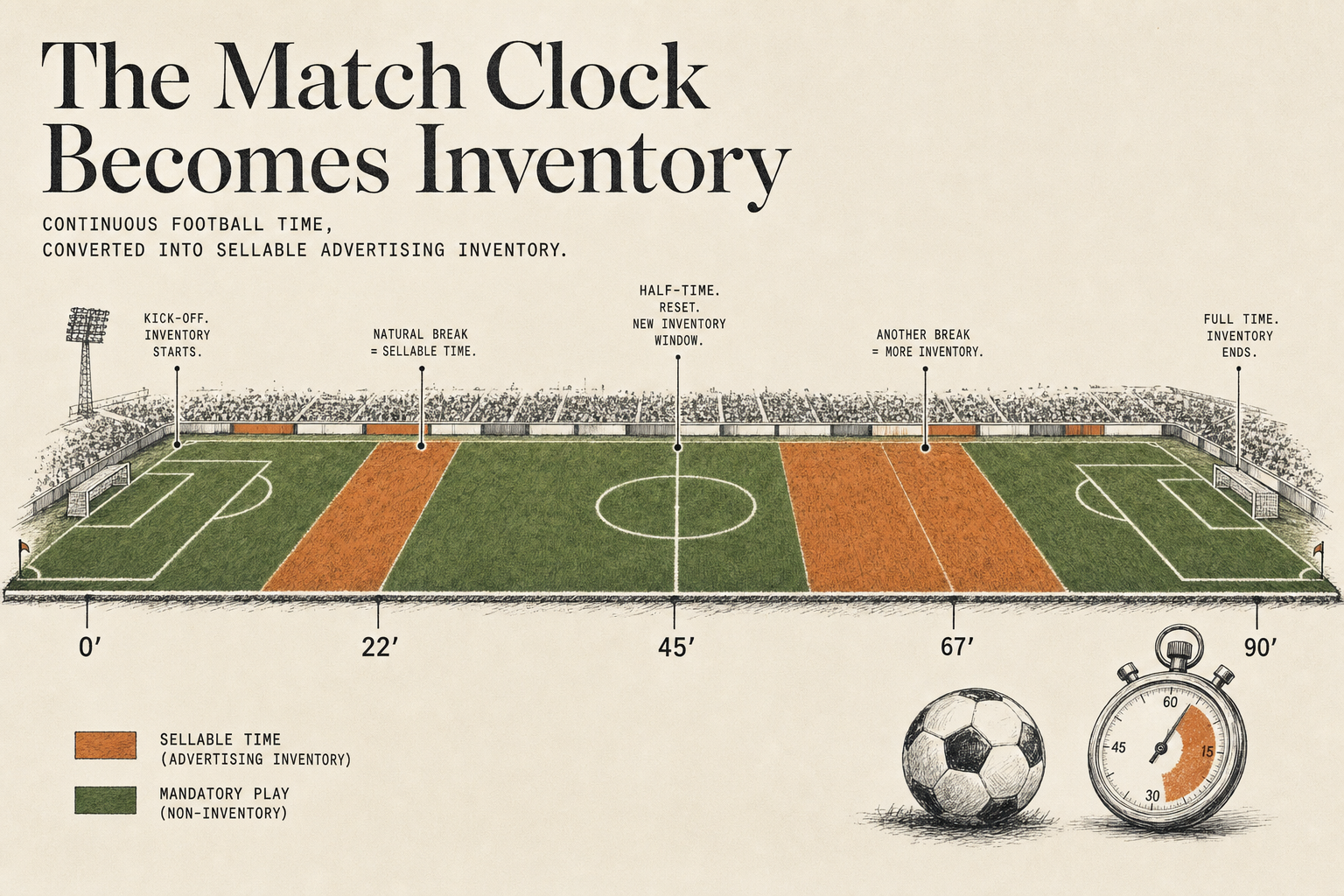
At minute twenty-two, the referee’s whistle no longer just governs the match. It opens the inventory.
The break in the game
The mandatory hydration break is the cleanest metaphor in modern football because it is also a balance-sheet item. At the 2026 World Cup, FIFA introduced three-minute pauses in every one of the tournament’s 104 matches, at roughly the twenty-second and sixty-seventh minutes, regardless of score, venue, roof, or temperature. Manolo Zubiria, the tournament’s chief officer for the United States, said the rule would apply “no matter where the games are played” and “no matter if there’s a roof” [1]. FIFA framed the decision as player welfare after complaints about heat at the 2025 Club World Cup. Critics heard a different whistle. David Goldblatt observed that “nobody needs three minutes to drink a glass of water,” while Ian Wright called the breaks “another way of getting adverts into it” [2].
The arithmetic supports the suspicion. Analysts estimated Fox Sports generated about $250 million in additional advertising revenue from the breaks, with 30-second slots priced between $200,000 and $300,000, rising to $750,000 for United States matches and $8 million for the final [3] [4]. FIFA says its broadcast deals were signed before the rule was announced. That may be contractually true. It is not commercially innocent. Once football has four sellable intervals, future rights become more valuable.
America was the experiment
The Americanization of football did not begin with a halftime show or a presidential phone call. It began on July 4, 1988, when FIFA awarded the 1994 World Cup to a country without a professional football league. The decision looked strange to much of the sport’s old world. One Italian journalist warned of “a World Cup for multinationals” [5]. Yet FIFA saw what European and South American hosts could not offer at the same scale: population, corporate infrastructure, disposable income, television distribution, and a sports market trained to turn attention into sponsorship.
The event worked. Total attendance reached 3,587,538, a record that still stands [6] [7]. The opening ceremony featured Stevie Wonder, Robin Williams, Oprah Winfrey, and Diana Ross [8]. Alan Rothenberg, who led the organizing committee, had considered changes that now read like parody: quarters instead of halves, larger balls and goals, even hockey-style movement around goalposts [8]. Sepp Blatter refused the most radical proposals, but the tournament still nudged the sport toward television logic. Three points for a win rewarded attack. The back-pass rule reduced time-killing. Yellow-card rules were modified. The 1994 World Cup was not a hostile takeover. It was a proof of concept.
The clubs became assets
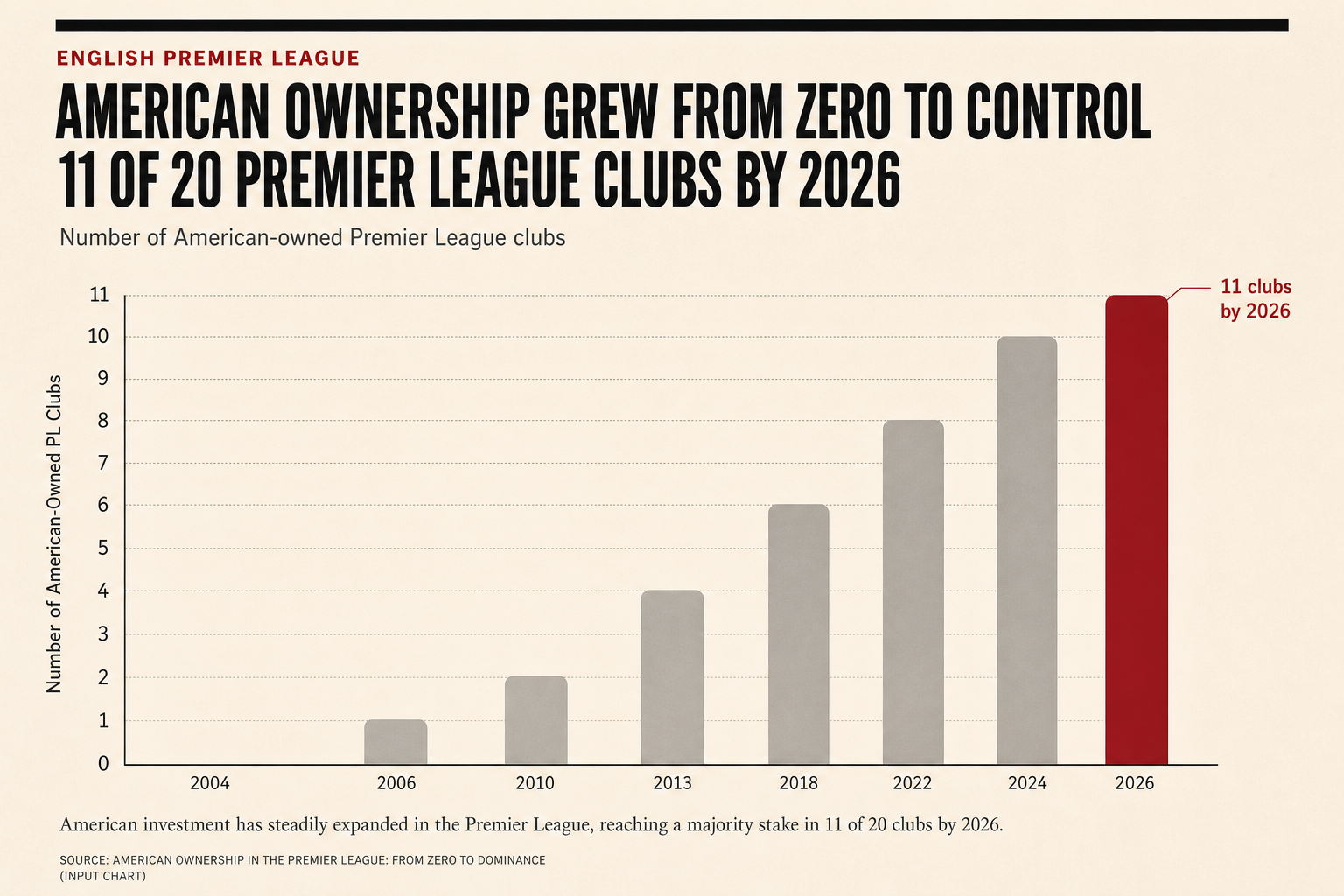
The deeper Americanization came later, through ownership. Before Malcolm Glazer completed his leveraged buyout of Manchester United in 2005, there was not a single American owner in European football [9]. By 2026, Americans held majority control of eleven of the Premier League’s twenty clubs [10]. Across the five major European leagues, American investors owned more than 40 clubs [11]. M&A activity in European football rose from €66.7 million in 2018 to €2.2 billion in 2024 [12].
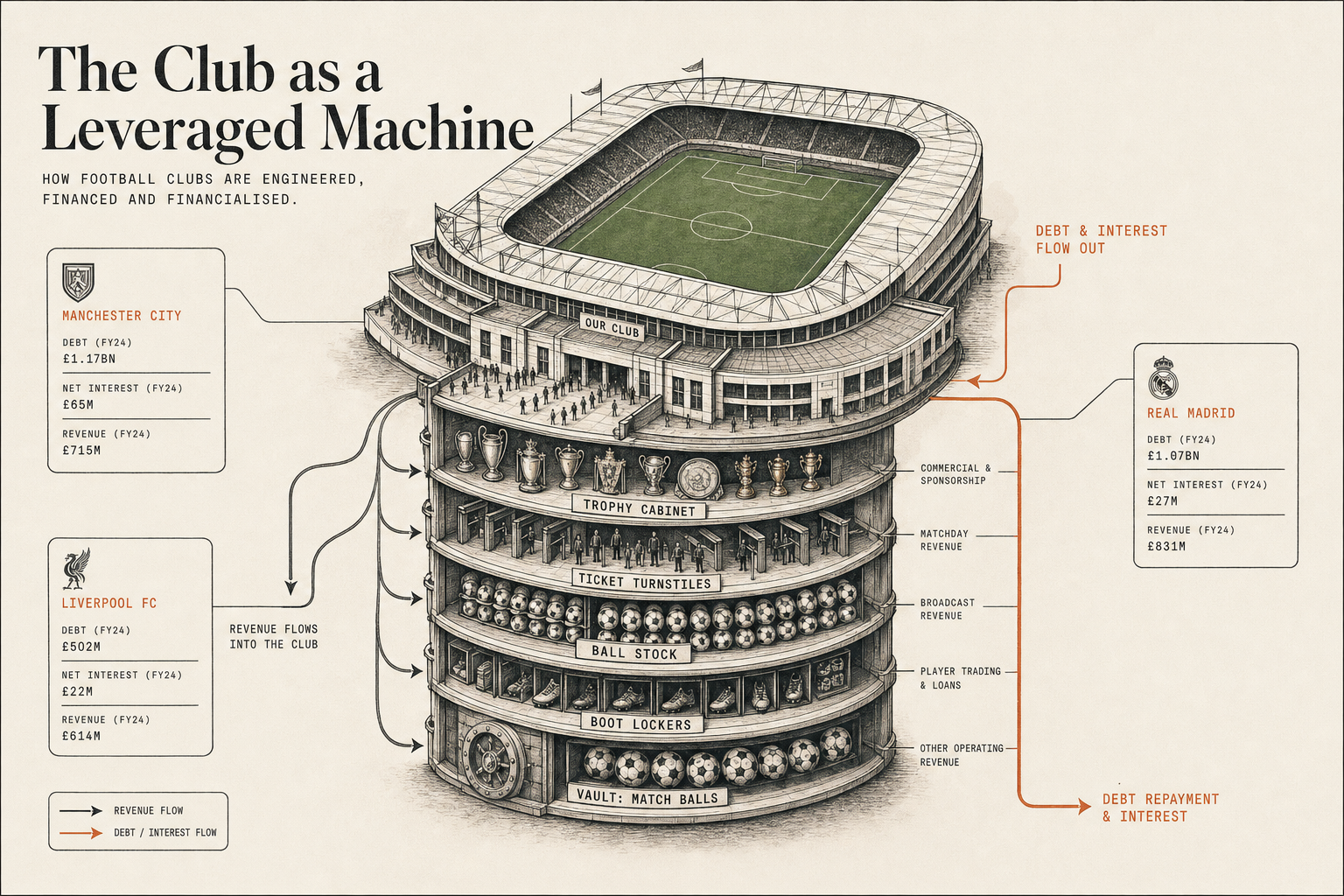
The models differ. Glazer’s Manchester United deal loaded more than £525 million of acquisition debt onto the club, while the family contributed about £270 million of its own capital [13] [14]. By February 2024, United had paid £969 million in cumulative interest since the takeover and still carried borrowings above £546 million [14]. Fenway Sports Group’s Liverpool tenure looked different: debt reduction, infrastructure, analytics, and revenue growth from roughly £187 million in 2010 to more than £600 million by 2023 [15]. Chelsea under Todd Boehly and Clearlake became the manic version, with a £4.25 billion total commitment and close to €2 billion in transfer spending over three years [16] [17]. The shared premise was the same: European football clubs were under-monetized cultural monopolies.
As Europeans, we have sold our souls to the highest bidders.
The player as proof of concept
Folarin Balogun’s story compresses the new football economy into one biography. He was born in Brooklyn in 2001 because airline staff would not let his seven-months-pregnant mother fly back to London. He returned to England as an infant, grew up there, joined Arsenal’s academy at eight, played for England youth teams, and became eligible for the United States by birth, England by upbringing, and Nigeria through his parents [18] [19] [20].
The United States did not develop him. It recruited him. US Soccer had tracked Balogun since 2021, then intensified its push in 2023 as he weighed his senior international future [21]. During a trip to Orlando, he met U.S. officials, sat courtside at an NBA game, attended Yankees spring training, and had dinner with Christian Pulisic, Weston McKennie, Yunus Musah, Tim Ream, and Matt Turner [22] [21]. Fans located him from an Instagram post and flooded his comments with American flags. FIFA approved his switch on May 16, 2023 [23] [24].
Balogun filled “a gaping hole in the player pool: a top-level No. 9” [22]. The fact that more than half the 2026 U.S. roster held dual citizenship showed both the country’s demographic power and its developmental weakness [25] [26]. America could sell the sport. It could recruit the sport. It still struggled to build it cheaply at home.
The Super Bowl temptation
Gianni Infantino has been unusually explicit about the destination. During Super Bowl week in Las Vegas in 2024, he said the 2026 World Cup would be “104 Super Bowls being played in North America” [27]. At the American Business Forum in Miami, he recast the tournament as “three Super Bowls a day” [28]. As market analyst Bob Dorfman noted, the comparison is commercially flattering and structurally false: the Super Bowl is a single national ritual with $7 million to $8 million ad slots, while a World Cup match is not automatically that kind of American television event [29] [28].
Still, the tournament presentation followed the analogy. The 2026 final at MetLife Stadium will include the first halftime entertainment spectacle in World Cup history, with Madonna, Shakira, Justin Bieber, BTS, Burna Boy, Gustavo Dudamel, the PS22 Chorus, and members of Coldplay attached to the show [30] [31] [32] [33]. The performance lasts about eleven minutes, while halftime stretches to 20 to 25 minutes for staging [31] [32]. That matters because Law 7, overseen by the International Football Association Board, says halftime must not exceed 15 minutes [34] [35]. FIFA is not merely dressing football in American spectacle. It is testing how much of football’s architecture can bend around spectacle.
Who pays for the party
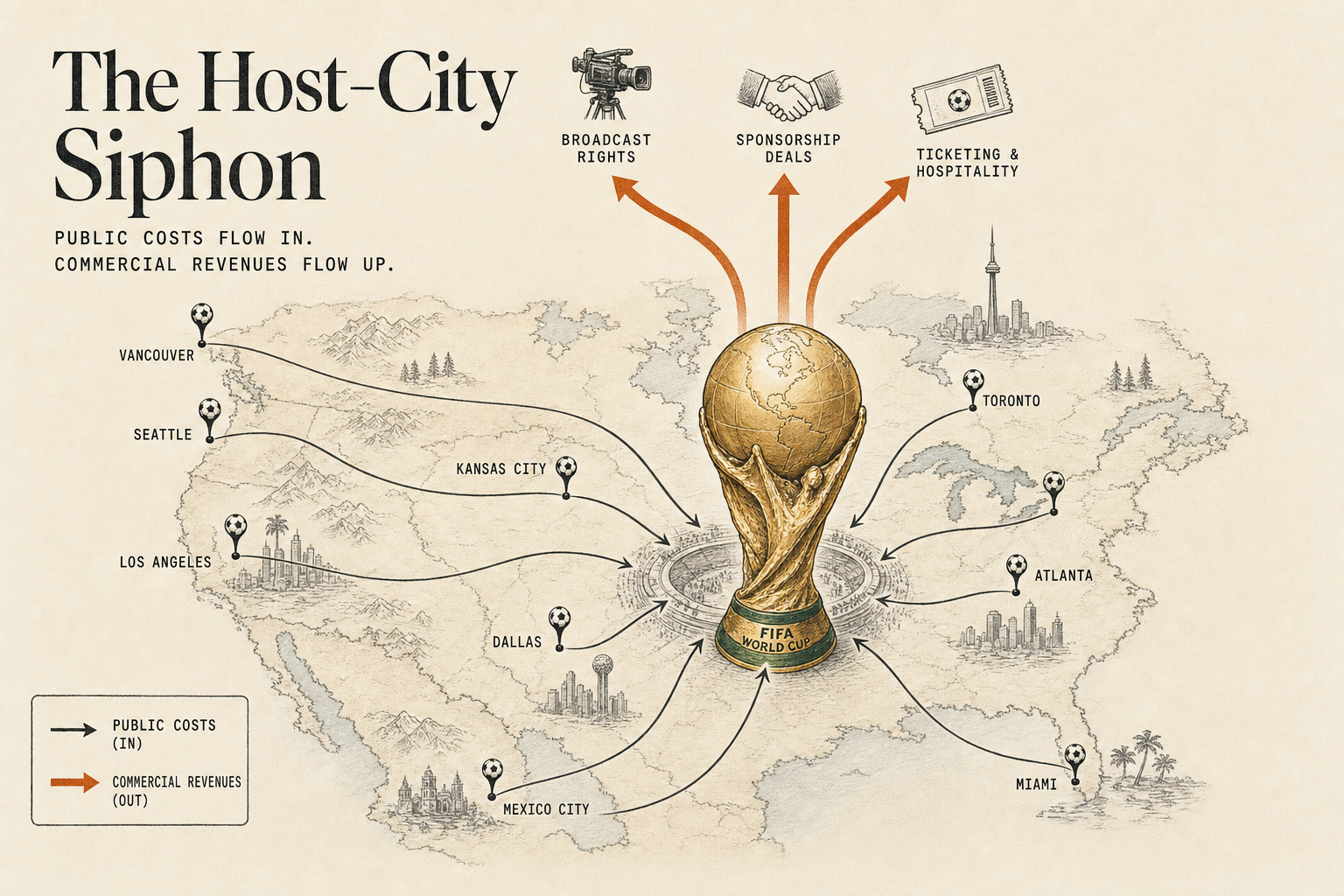
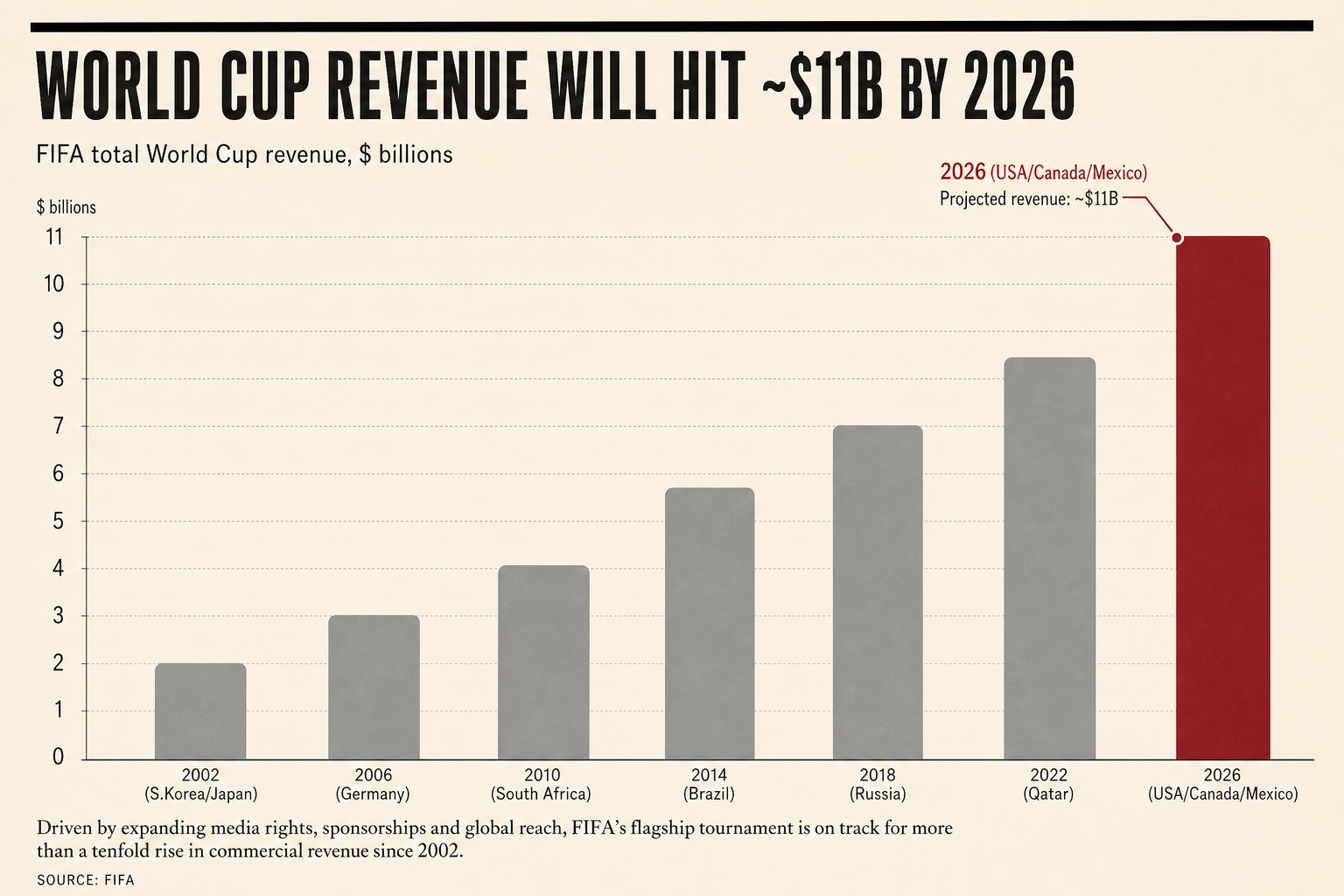
The 2026 World Cup is projected to deliver about $8.9 billion to FIFA from the tournament, with the 2023-2026 commercial cycle targeting $13 billion [36] [37] [38]. Broadcast rights total $3.92 billion, sponsorship reached $2.8 billion, and all sixteen global sponsorship positions sold out for the first time in World Cup history [39] [40] [41]. Prize money rose from $440 million in 2022 to $871 million in 2026 [42]. American companies now provide 52 percent of sponsorship revenue, up from 36 percent in 2022 [43].
Host cities sit on the other side of the ledger. The eleven U.S. host cities face a shortfall estimated at up to $250 million despite $625 million in federal security funding and $100 million in federal transit support [44] [45]. They pay for transport, safety, and infrastructure while FIFA keeps the commercial revenue. Economist Andrew Zimbalist put it bluntly: “none of them will benefit economically from the World Cup because they don’t get the revenue, but they get the costs” [46] [45]. The fan pays too. The cheapest ticket to the final costs £3,119, nearly 500 percent more than the equivalent at Qatar 2022 [47]. FIFA also runs a resale marketplace and takes 15 percent from both buyer and seller [48].
The base of the pyramid
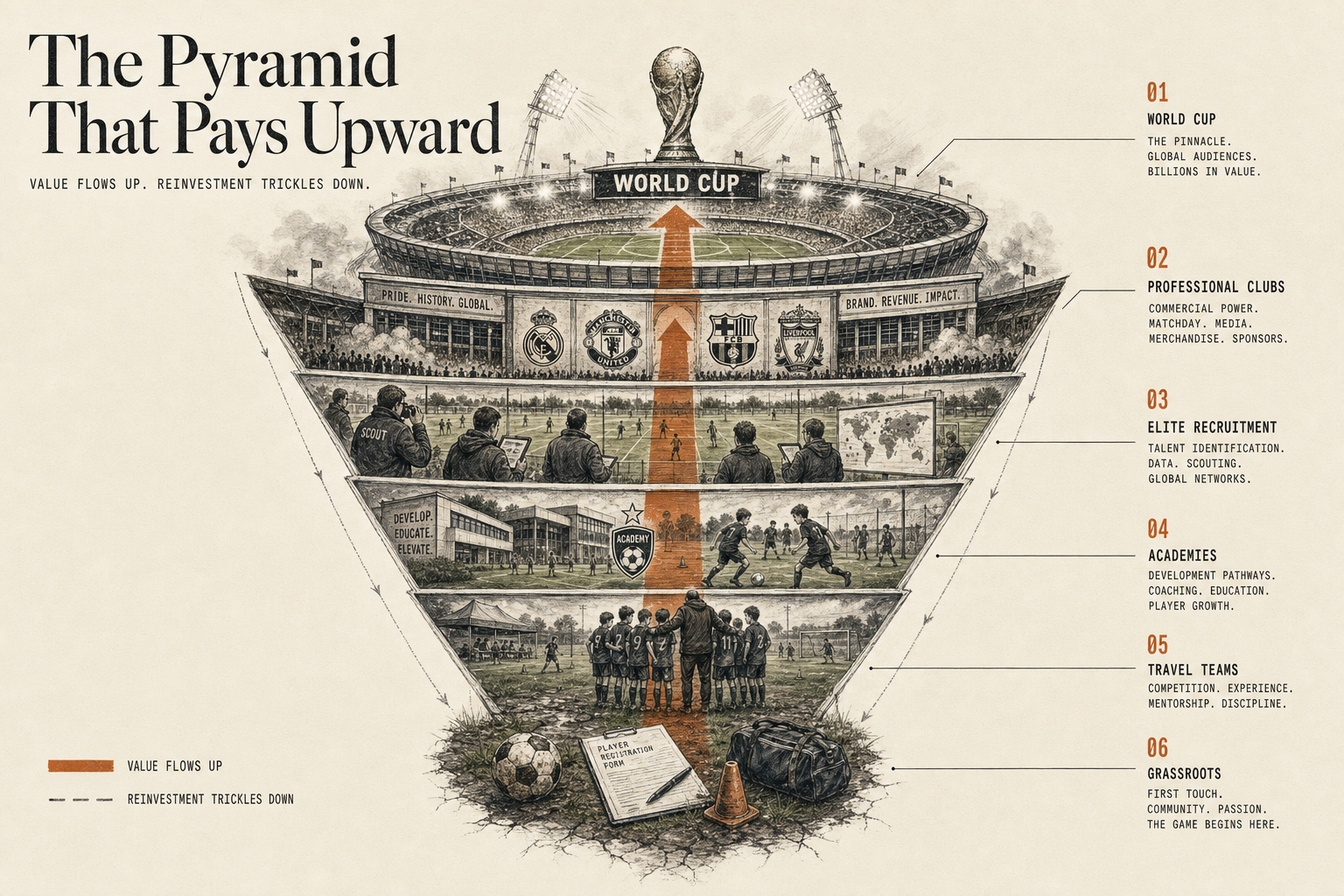
The harshest irony is that the country central to FIFA’s commercial future still prices many children out of the sport. Youth soccer costs in the United States rose 69 percent in five years, from an average family expenditure of $537 in 2019 to $910 in 2024 [49]. Thirty-two percent of youth players cite expensive team fees as a major barrier, rising to 41 percent among low-income families [50] [51]. Participation among six-to-twelve-year-olds fell 5.5 percent between 2013 and 2023 even as the World Cup approached [49].
FIFA has invested $5.1 billion through its Forward Programme between 2016 and 2026, around $425 million annually, to support global grassroots football [52] [53]. That is real money. It is also small beside what FIFA can extract from one tournament. Grassroots football is where the social return lives: health, community, volunteer networks, and the first touch of future professionals. UEFA estimates every euro invested in grassroots football returns four euros in social value [54]. Yet the modern system channels value upward, from cities to FIFA, from supporters to resale fees, from clubs to financiers, from children’s participation to elite spectacle.
- The Americanization of football is less about American fans than American monetization: advertising inventory, media rights, sponsorship categories, private ownership, and event spectacle.
- FIFA’s 2026 model expands the World Cup’s revenue while shifting substantial costs to host cities and fans.
- American ownership has professionalized parts of European football, but it has also turned clubs into leveraged, optimized, globally traded assets.
- The unresolved question is whether football can grow in the U.S. without importing the structural habits that make American sports more interruptible, more expensive, and more closed.
What cannot be undone
There are still brakes in the system. IFAB rejected Arsène Wenger’s proposed “daylight offside rule” in January 2026 as “too radical,” reminding FIFA that it cannot unilaterally rewrite the Laws of the Game [55] [56]. UEFA says mandatory hydration breaks will not be used at Euro 2028 or in the Champions League [57] [58]. Britain’s Football Governance Act 2025 created an Independent Football Regulator with powers over the top five tiers and a new suitability test for owners [13]. Resistance is real.
But the direction of travel is also real. American capital controls a majority of Premier League clubs. The next U.S. World Cup rights auction is expected to begin at $1 billion, with Netflix, Disney, YouTube, Amazon, ESPN, and Fox among potential bidders [59]. FIFPRO and European leagues have filed legal challenges over FIFA’s unilateral calendar expansion, while players warn that the schedule is reaching breaking point [60] [61] [62].
Football’s gift is its continuity: two halves, few stoppages, no coach’s timeout, no guaranteed pause before consequence. That is also its commercial inconvenience. The water break is FIFA’s answer to that inconvenience. The next decade will show whether it remains an exception, or becomes the sound of the world’s game learning to stop on command.
Get the next issue in your inbox.
Free, weekly. One company or market, taken completely apart — every figure sourced and verified with Valyu DeepResearch.
Issue queued.
Your next cited briefing is on its way to .