
Keynes was right about abundance and wrong about leisure, which is why the future of work now feels less like a productivity story than a distribution crisis. [1]
The prophecy that half came true
In 1930, with capitalism apparently collapsing around him, John Maynard Keynes wrote a strangely optimistic essay. Within a century, he argued, living standards in progressive countries would be four to eight times higher, and humanity would confront a problem it had never truly faced: not subsistence, but leisure. [2]
The wealth forecast was remarkably close. U.S. GDP per capita has risen approximately 6.5 times since 1930, broadly matching his projection. [1] The work forecast failed. Keynes imagined a 15-hour workweek by 2030; the average American worker still works close to eight hours a day. [3]
That divergence is the cleanest way into the present moment. Technology did deliver abundance. It did not automatically convert abundance into rest, security, or broadly shared freedom. The same mistake shadows today's AI debate: a confusion between what technology can produce and how its gains are allocated.
Automation always destroys tasks before it creates futures
The old reassurance is not false. The lump of labor fallacy, the belief that there is a fixed amount of work and automation must therefore permanently destroy jobs, has been refuted repeatedly. [4] U.S. agricultural employment fell from 41 percent of the workforce in 1900 to 2 percent by 2000, while total employment grew. [5] ATMs spread rapidly between 1995 and 2010, yet bank teller employment rose modestly as branches became cheaper to operate and teller work shifted toward relationships. [6]
But the aggregate story hides the transition. Daron Acemoglu and Pascual Restrepo's task model separates automation's displacement effect, which removes labor from existing tasks, from the reinstatement effect, which creates new tasks where labor regains advantage. [7] From 1947 to 1987, the two were roughly balanced. After 1987, displacement ran at approximately 0.70 percent per year while reinstatement added only 0.35 percent. [7]
That imbalance was lived as polarization: real earnings for men with exactly a high school diploma fell 21 percent between 1979 and 2017, while earnings for men with post-baccalaureate degrees rose 43 percent. [8] Technology created work. It did not create equivalent work for everyone.
The arithmetic changed before the culture noticed
What makes the current AI wave different is not that machines are suddenly magical. It is that four thresholds crossed together. Reasoning models began handling more multi-step logic. Long-term memory architectures made continuous adaptation possible without full retraining. Agentic systems moved from demonstration to enterprise workflow. And the price collapsed. [9] [10]
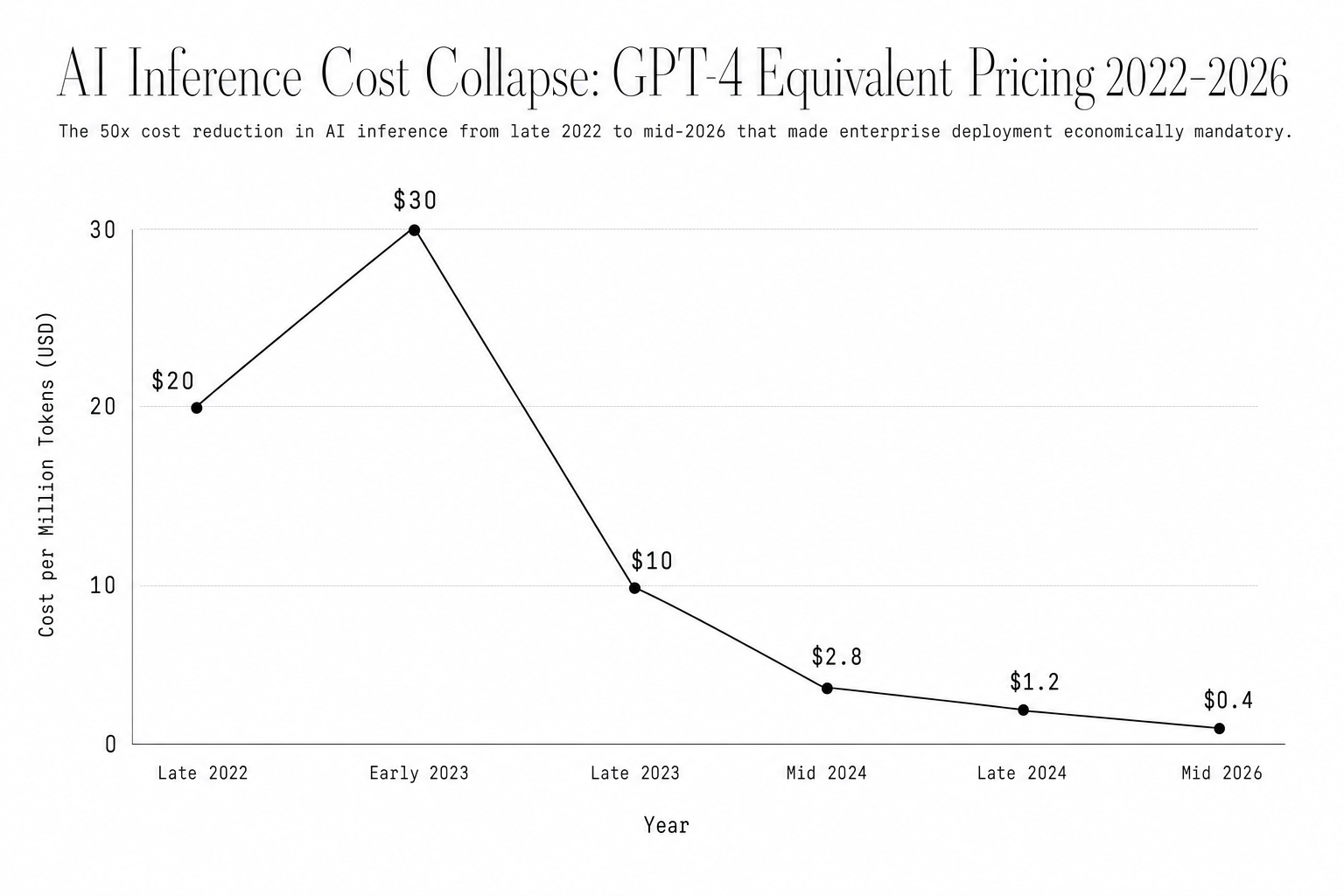
The cost of deploying AI capability equivalent to GPT-4 fell from $20 per million tokens in late 2022 to approximately $0.40 per million tokens by mid-2026, a roughly fifty-fold reduction. [11] [12] Frontier models have seen annual inference cost declines of approximately ten times since 2021. [11]
That is the underappreciated fact. Public debate tends to ask whether models are intelligent. Firms ask a colder question: whether a machine can perform routine components of knowledge work for less than the fully loaded cost of a worker. When the answer becomes yes at scale, adoption stops being a curiosity and becomes pressure.
The frontier is jagged, not smooth
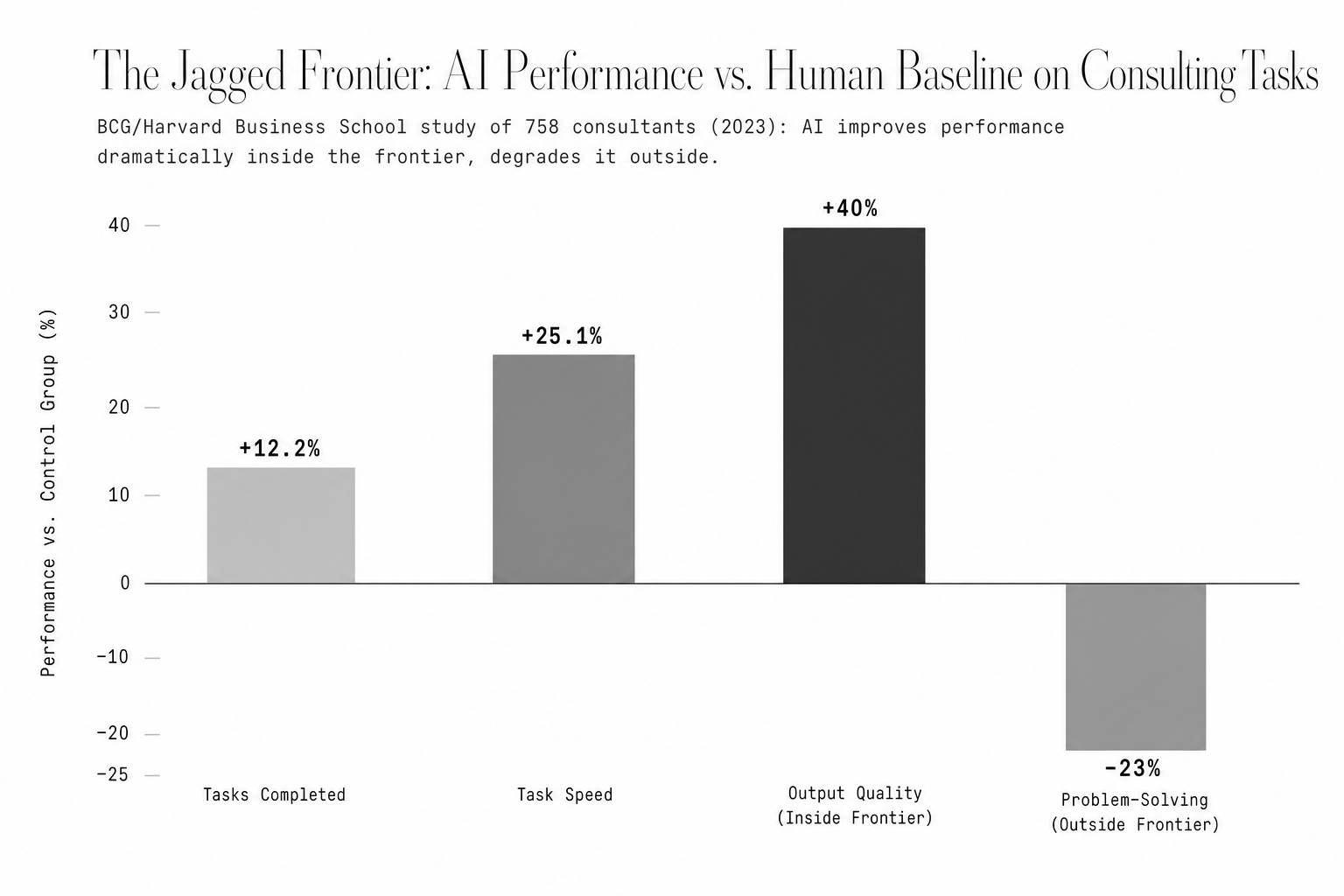
AI capability does not arrive evenly. In 2023, researchers from Harvard Business School and Boston Consulting Group ran a field experiment with 758 BCG consultants across 18 realistic business tasks. Their phrase for the result, the “jagged technological frontier,” remains the best mental model. [13] [14]
Inside the frontier, GPT-4 helped consultants complete 12.2 percent more tasks, finish 25.1 percent faster, and produce work rated 40 percent higher in quality. Junior consultants benefited most. [15] [16] Outside the frontier, on work requiring causal reasoning, operational context, and judgment, AI users performed 23 percent worse and were 19 percentage points more likely to produce incorrect solutions. [17] [16]
The danger was not obvious stupidity. It was fluent error. Wrong answers arrived in the right format, with the confidence of competence. The best workers learned to behave like “Centaurs,” deliberately dividing labor between human and machine depending on which side of the frontier a task occupied. [14] The frontier has since moved, but the lesson remains: AI augments powerfully where it is reliable, and degrades work where it seduces judgment into sleep.
Productivity is still missing from the macro data
The strongest case for AI is that it will eventually lift growth. Goldman Sachs projected in 2023 that generative AI could raise global GDP by 7 percent, or almost $7 trillion in additional annual output over a ten-year adoption period. [18] It estimated a potential 1.5 percentage point annual boost to U.S. labor productivity growth. [19]
By 2026, the picture was messier. Goldman's Jan Hatzius said AI investments contributed “basically zero” to U.S. economic growth in 2025, and the bank found no meaningful economy-wide relationship between AI adoption and productivity. [20] [21] Yet companies that had successfully integrated and measured AI reported median productivity gains of around 30 percent on specific tasks. [21]
This is not necessarily a contradiction. Electricity and personal computers took more than a decade to show up clearly in productivity statistics. [19] The missing ingredient is workflow redesign. BCG found that only 5 percent of companies were achieving AI value at scale, while 60 percent saw minimal revenue or cost gains despite substantial investment. [22] The failure is often organizational, not technical. [23]
If it were the case that 30, 40 percent of new university graduates can't find jobs, what would that do to democracy and social peace?
What machines still cannot carry
The most durable protection against automation lies where work combines embodiment, tacit knowledge, human relation, and accountability. Moravec's Paradox explains why: computers can perform adult-level symbolic tasks more easily than they can master the perception and mobility of a one-year-old. [24] Robotics still struggles with deformable objects, unfamiliar geometries, and cluttered environments that humans navigate without conscious calculation. Amazon's Vulcan can handle around 75 percent of more than one million fulfillment items, leaving the remaining 25 percent to human dexterity and judgment. [25]
Polanyi's Paradox adds the knowledge problem: “we can know more than we can tell.” [26] Apprenticeship transmits expertise that masters themselves cannot fully formalize. [27] That matters in medicine, design, repair, management, therapy, and every occupation where the real task is not executing a rule but knowing which rule applies, when it fails, and who bears the consequence.
AI can simulate empathy, generate novelty, and draft plausible reasoning. But research still finds limits in appropriateness, moral judgment, embodied understanding, and self-reflection. [28] [29] [30] The future of work is therefore not a simple split between humans and machines. It is a sorting of tasks by whether they can be formalized without losing what makes them valuable.
- AI is not likely to eliminate work in aggregate, but it can accelerate the gap between displaced tasks and newly created, well-paid tasks.
- The decisive economic shift is cost: once routine knowledge work becomes cheaper to automate than to staff, adoption pressure becomes structural.
- The “jagged frontier” is the operating model: AI sharply improves some tasks and quietly damages others through fluent, plausible error.
- The central policy problem is not technological capability but whether institutions can distribute productivity gains before displacement becomes politically destabilizing.
The unfinished bargain
Work is not only income. People spend approximately one-third of waking hours at work, and Marie Jahoda's research identified employment's latent functions: time structure, social contact, collective purpose, identity and status, and regular activity. [31] Unemployment removes them together, which is why its psychological damage exceeds income loss alone. [31]
The World Economic Forum projects 170 million new jobs globally by 2030 and 92 million displaced, a net gain of 78 million. [32] That is reassuring only at the altitude of the aggregate. The displaced roles are concentrated in customer service, food service, production, and office support, and McKinsey estimates that 80 percent of the 12 million U.S. occupational transitions needed by 2030 will occur in those four categories. [33]
Keynes's grandchildren became wealthy. They did not inherit the leisure republic he imagined, because productivity does not distribute itself. The real AI question is not whether work survives. It is whether reinstatement happens quickly enough, at adequate wages, in roles that still carry dignity. The technology will not answer that. Institutions will.
Get the next issue in your inbox.
Free, weekly. One company or market, taken completely apart — every figure sourced and verified with Valyu DeepResearch.
Issue queued.
Your next cited briefing is on its way to .